
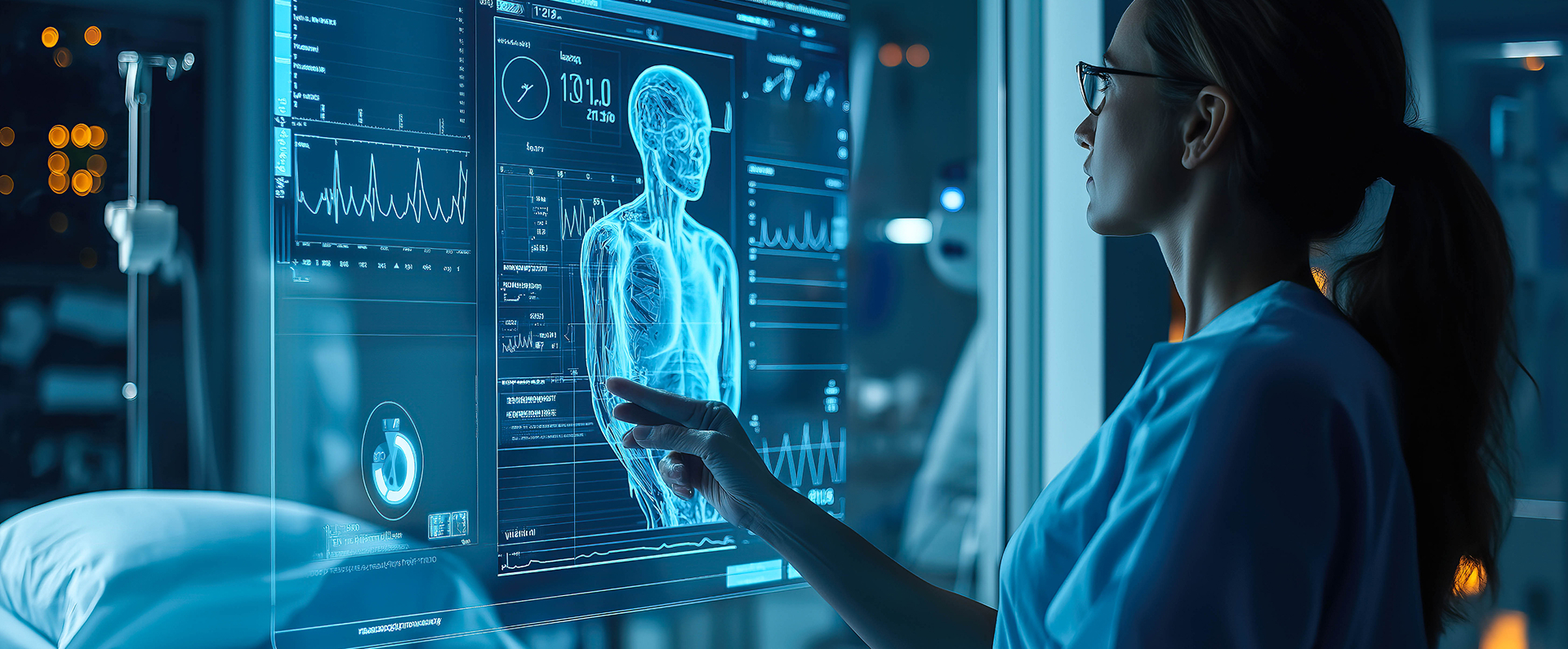
How AI in Healthcare Is Transforming Medical Imaging, Diagnostics, and Predictive Patient Care

Technomark
Mar 12, 2026
7 min read
 0 like
The healthcare industry is undergoing a significant shift due to a new wave of healthcare technologies enabled by AI. The traditional healthcare system has some challenges, such as a rise in patient numbers, delayed diagnosis of diseases, and a corresponding increase in operational costs. However, the use of artificial intelligence coupled with healthcare technologies is changing the way healthcare providers diagnose diseases, analyze medical data, and provide patient care services.
From artificial intelligence in medical imaging to artificial intelligence in medical diagnostics and predictive patient care services, healthcare artificial intelligence is helping doctors make quicker and more precise decisions. By using machine learning in healthcare services and predictive analytics, healthcare providers are able to process large data sets, identify patterns, and predict health risks before they become severe.
This is changing the way healthcare providers are moving towards a more proactive approach to healthcare services.
The term "AI in healthcare" refers to the use of sophisticated machine learning techniques and tools, as well as deep learning and data analytics technology, to process large amounts of healthcare-related data and produce valuable insights. Healthcare organizations have the ability to collect a massive amount of data on a daily basis in the form of electronic patient records, test results, scans, and patient history. These large amounts of data cannot be efficiently analyzed using traditional analysis techniques.
With the help of AI healthcare technology, healthcare organizations can efficiently analyze medical data and find hidden patterns in the data using machine learning techniques. Using predictive analytics in healthcare with the help of machine learning techniques and tools, healthcare providers can efficiently diagnose diseases at an early stage and improve clinical decisions. Hence, AI medical solutions have become an essential part of healthcare systems across the globe.
The most prominent use cases for the application of AI in healthcare have been witnessed in the use cases related to “AI for medical imaging and radiology.” Medical imaging techniques, such as X-rays, CT scans, and ultrasounds, produce highly complex visual data, and the interpretation of these images is a complex task for specialists. However, with the application of AI technologies, the efficiency and accuracy of these imaging techniques have improved considerably.
Medical imaging is a technique by which a computer is enabled to use its learning algorithms to examine medical images and identify patterns that may be indicative of certain abnormalities. These technologies are capable of detecting conditions such as tumors, fractures, and internal bleeding with high levels of accuracy. Moreover, the application of AI technologies in the field of radiology has also improved the efficiency with which images are analyzed, enabling doctors to provide quicker diagnosis and treatment.
Furthermore, the application of AI technologies in medical diagnostics has also reduced the chances of errors and has enabled doctors to make more confident decisions. Many AI healthcare startups are developing new and innovative imaging technologies that may be used for the early diagnosis and detection of conditions.
The application of AI in medical diagnostics is growing rapidly as healthcare organizations are increasingly using intelligent technology to aid doctors in decision-making. The conventional diagnostic techniques are often lengthy processes that involve various tests and consultations with specialists. AI technology is helping to simplify these processes by using patient information such as symptoms, medical history, test results, and genetic information to aid doctors in diagnosing diseases accurately.
Advanced AI patient diagnostic technology is helping healthcare professionals to identify various patterns in patient information to diagnose diseases in earlier stages. AI technology is being used to aid doctors in diagnosing rare diseases that are difficult to identify. Such technology is helping to improve accuracy in medical diagnoses and reduce the time required to identify medical conditions.
Moreover, AI technology is being used in disease prediction to help healthcare providers identify patient risk factors and predict diseases such as diabetes, heart diseases, and respiratory diseases. Such technology is helping to improve patient care through preventive measures that are effective in predictive patient care.
The most significant and revolutionary change in healthcare AI is related to the adoption and use of predictive analytics in healthcare. Predictive analytics is defined as an approach in healthcare data analysis, where historical data is utilized to forecast future healthcare outcomes through machine learning algorithms and statistical models.
The significance and importance of predictive analytics in healthcare are on the rise, particularly in healthcare institutions that seek to provide proactive and preventive healthcare services. By making use of AI predictive analytics in healthcare, healthcare institutions can effectively manage healthcare resources and improve healthcare outcomes. The adoption and utilization of predictive analytics in healthcare have helped healthcare institutions move from reactive healthcare approaches to proactive healthcare approaches.
There are a lot of predictive analytics use cases in healthcare that show the impact of AI-driven technology on modern healthcare systems. Some of the most important use cases of predictive analytics in healthcare include early disease detection. In early disease detection, AI technology plays a crucial role in analyzing patient data and recognizing patterns in the data that may indicate a future health problem.
Another important use case of predictive analytics in healthcare is hospital readmission prediction. Predictive analytics helps in predicting those patients who may be readmitted to the hospital. By using predictive analytics in healthcare, hospital staff can take necessary steps in preventing hospital readmissions.
Another use case of predictive analytics in healthcare is personalized treatment planning. Using predictive
analytics in patient care helps a doctor analyze a patient's data and plan a treatment that may have a successful outcome. Predictive analytics applications in healthcare also help medical researchers discover new drugs using biological data.
The use cases of predictive analytics in healthcare discussed above show the impact of AI technology on modern healthcare systems.
The integration of AI and predictive analytics in healthcare has many benefits to healthcare providers and patients. Some of the benefits include:
The benefits to patients include better health outcomes due to earlier detection of diseases through AI technology. Healthcare providers can improve efficiency in healthcare services through AI technology to improve healthcare services and reduce costs. This is achieved through optimized hospital operations and efficient resource management. As a result, healthcare costs are reduced and patient experience is improved.
Another major benefit associated with AI healthcare technology is the ability to support personalized medicine. Using individual patient data, AI technology can help in providing customized treatment recommendations to patients. These benefits illustrate the significance of predictive analytics in healthcare services.
The future of predictive analytics in healthcare is likely to be characterized by further groundbreaking innovations. As AI technology continues to advance, healthcare services are likely to increasingly depend on intelligent technology to aid in diagnosis and treatment, as well as patient management.
The emerging trends in AI healthcare innovation include AI-assisted robotic surgeries, patient monitoring through wearable devices, and intelligent clinical decision support systems through machine learning technology. These technologies are likely to enable healthcare services to be delivered quickly and accurately.
The future of AI predictive analytics in healthcare is likely to be characterized by further advancements in preventive healthcare services, personalized healthcare services, and population health management services. As such, healthcare services are likely to be efficient across the globe.
The widespread use of AI technology in the healthcare sector, AI patient diagnostics, and healthcare predictive analytics are changing the way medical services are delivered. From AI technology in medical imaging and radiology to AI patient diagnostics and disease prediction, artificial intelligence is changing the way healthcare providers deliver medical care to patients.
By using AI healthcare technology and predictive healthcare analytics, healthcare providers and organizations can improve the accuracy of patient diagnosis and care while reducing the cost of healthcare delivery. As the healthcare industry evolves, AI healthcare solutions will be at the core of the future of modern medicine.
The use of AI technology and predictive healthcare analytics in the healthcare sector is a major move towards creating an intelligent healthcare system.
Share article


Loading related articles…